If you’re searching for a Foshan furniture sourcing agent,
you probably already realize one thing:
This is not something you can manage efficiently on your own.
But what most people don’t realize is —
finding “someone to help” is actually the easy part.
Finding the right kind of help is where things start to go wrong.
Foshan Is Not One Market
A lot of clients assume Foshan is a structured furniture market.
It’s not.
It’s a fragmented supply chain system.
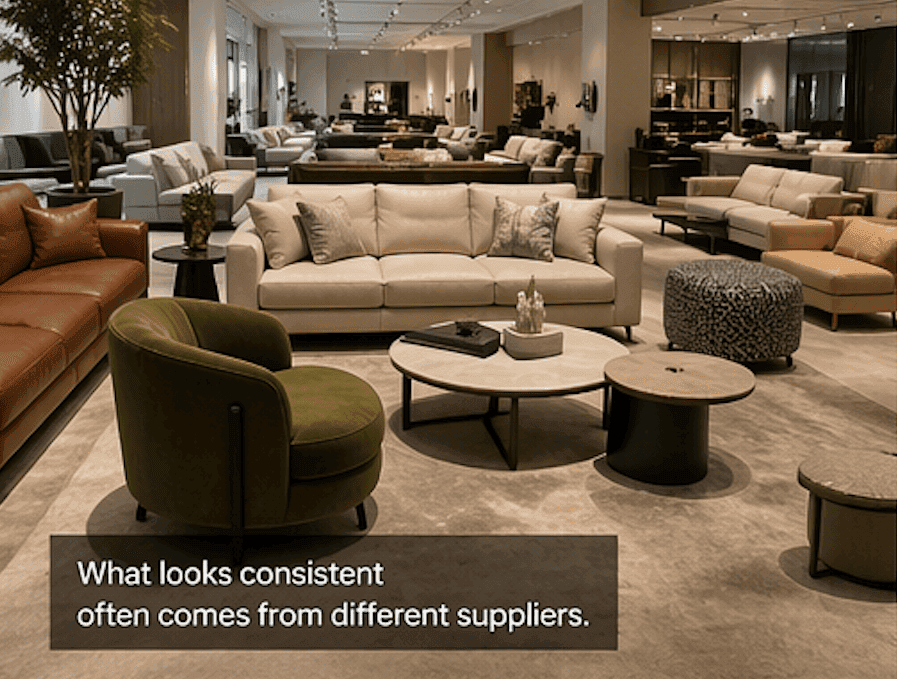
- Sofas, cabinetry, lighting, outdoor furniture — all come from completely different factory networks
- Even within the same showroom, products may come from different suppliers
- What looks consistent at first is often difficult to control when executed together
So selecting products feels easy.
But making everything work as a complete project is where complexity begins.
The Real Problems Are Not About Price
Most people assume sourcing problems come from pricing.
They don’t.
The more common issues are structural:
- lack of consistency across different categories
- materials and finishes that don’t align as a whole
- overestimated customization capabilities
- no coordination between multiple factories
These problems don’t show up when you’re choosing products.
They show up when everything needs to come together.
Where Most Issues Actually Come From
Most risks don’t come from obvious mistakes.
They come from a gap in thinking.
Factories operate with a production mindset.
They focus on making what is requested.
But a project is not just a collection of individual items.
And most clients, especially at the early stage,
don’t yet have enough experience to define every detail clearly.
So small decisions get made without full context:
- materials are chosen based on appearance, not performance
- finishes look fine individually, but don’t work together
- dimensions are technically correct, but not right for the space
- structural details only become issues during installation
Another Overlooked Factor: Standards and Real-World Application
Beyond supply chain complexity, there is another layer that often gets ignored —
differences in standards between countries.
These issues don’t seem critical at the beginning,
but they become very real during execution:
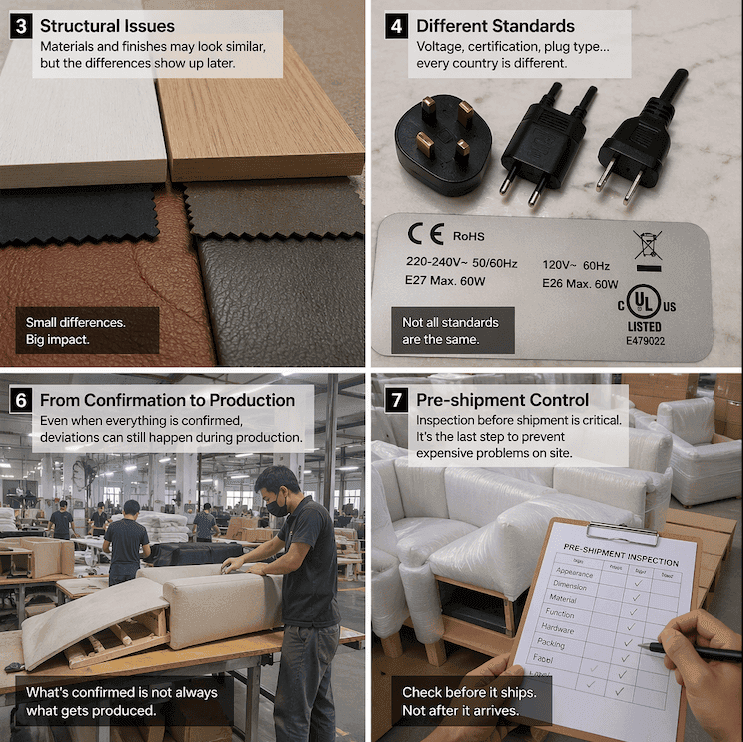
- lighting involves different voltage, certifications, and connection requirements
- custom cabinetry depends on site conditions, installation methods, and structural allowances
- certain materials and finishes may look fine in samples, but behave differently in actual use
A lot of things are “possible” from a factory perspective.
But “possible to produce” does not always mean
“suitable for your project.”
From Confirmation to Production — There Is Another Gap
Even when communication is clear, problems can still happen.
Drawings are confirmed.
Details are discussed.
Everything seems aligned.
But once production starts, execution is handled by different workers.
And at that stage, interpretation and implementation can vary.
For example:
- details may be simplified or misunderstood during handover
- techniques may be adjusted in practice without feedback
- small deviations may seem minor individually, but become noticeable in bulk
These are not rare situations.
The issue is —
if there is no control before shipment,
these deviations go all the way to final delivery.
And once they reach the site,
corrections become significantly more expensive.
So, Is It Worth Sourcing from China?
This is one of the most common questions I get.
My answer is simple — it depends on what you’re trying to do.
If you are working on a full project,
then yes, it is worth it.
If you want to customize products or turn references into real pieces,
then yes, it makes sense.
If your goal is to achieve better quality at a more reasonable price compared to your local market,
then again, it works.
But there are also cases where it doesn’t.
If you only need a few standalone items,
or you’re looking for very basic, low-end products,
then coming to China is often not the most efficient option.
Not because it can’t be done,
but because the structure doesn’t make sense.
What I Actually Do
I don’t represent a single factory.
And I’m not here just to take you around showrooms.
What I do is build the right sourcing structure for your project.
That includes:
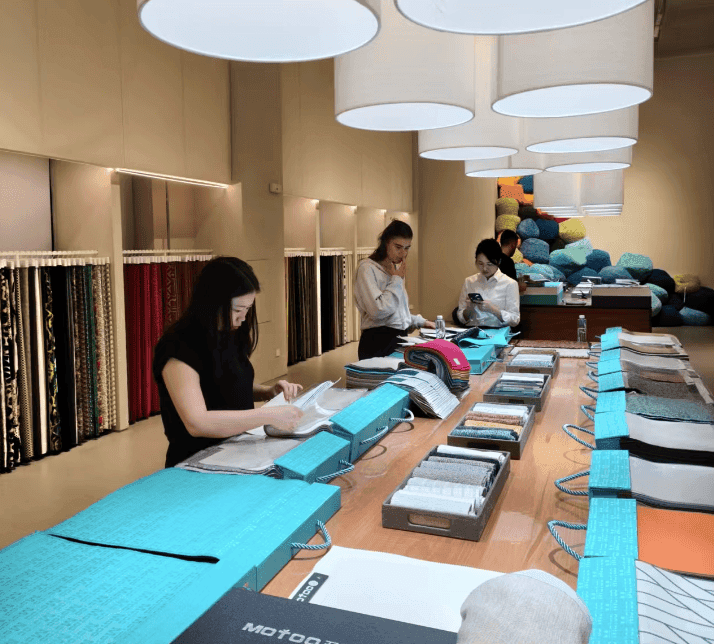
- matching the right factories for each category
- aligning your design expectations with real supply capabilities
- maintaining consistency across materials and finishes
- identifying potential problems early, and removing them before they happen
Sometimes this also means telling you not to do something.
And in many cases, that’s where the real value is.

My Final Thought
If you want your project to actually work — to be efficient, cost-controlled, and truly successful — then you need the right person involved from the very beginning.
I’ve been doing this for over six years, and I’ve learned to stay very grounded in how things actually work. No overpromising, no idealized assumptions — just working with what’s real, and making decisions based on that.
What I care about is simple: when everything arrives, gets installed, and the space comes together — and the client is genuinely happy with the result. That’s what I’m working toward.