I started working in furniture sourcing in Foshan in 2013.
Over the years, I’ve worked on many different furniture projects, and custom furniture has become a very important part of what I do.
So in this article, I want to share some of my real experience with custom furniture in China — what makes it valuable, when it makes sense, and some of the problems I’ve actually experienced during real projects.
What do I mean by “custom furniture”?
When I say custom furniture here, I’m not simply talking about changing the size, color, or fabric of an existing product.
Many furniture factories in China can already do these things as part of their normal production.
What I’m talking about is more about developing and producing a new piece of furniture based on a design, reference image, rendering, or the client’s own idea.
This is actually a very common situation with my clients.
Many of them find a piece of furniture from a well-known brand or designer overseas that they really love, but the original price is simply too high.
Sometimes the original piece costs several thousand dollars, or even more than USD 10,000.
They love the design, but they don’t necessarily want to spend that much on the original piece.
So they send me the furniture image, rendering, or design reference and ask if we can develop something similar in China.
This is one of the most common types of custom furniture projects I work on.
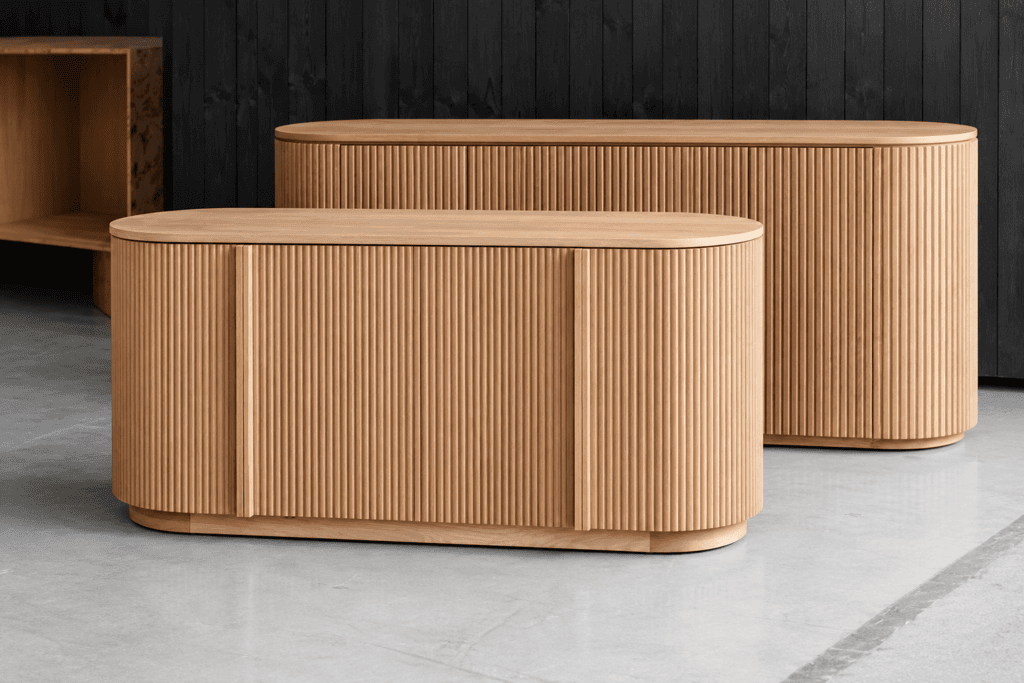
Custom-made Oak wood sideboard
So for these clients, choosing China is not only about getting a lower price.
It is also about having the opportunity to achieve a design they really love within a more reasonable budget.
And this type of custom furniture is very different from simply buying a ready-made product.
It involves understanding the design, structure, materials, workmanship, CAD drawings, samples and production process.
That is why custom furniture can be much more complicated than it looks.
Why choose China for custom furniture?
In my opinion, the biggest advantage of custom furniture in China is not simply the price.
China has a very mature and complete furniture supply chain.
For woodwork, painting, upholstery, hardware, fabrics, veneers, metalwork and many different finishes, there are factories and suppliers with specialized production capabilities.
For clients, this means more choices and much more freedom when it comes to design.
For example, a client may really love a high-end or designer piece of furniture, but the original price is simply too high.
Instead of buying the original, we can use the design as a reference and develop a new piece in China that is suitable for the project.
Of course, this is not simply about “making an expensive product cheaper.”
We still need to consider the client’s budget, materials, workmanship, production methods and the actual requirements of the project.
Then we work with the right factory to develop the product accordingly.
That is what I think makes China’s furniture supply chain so useful.
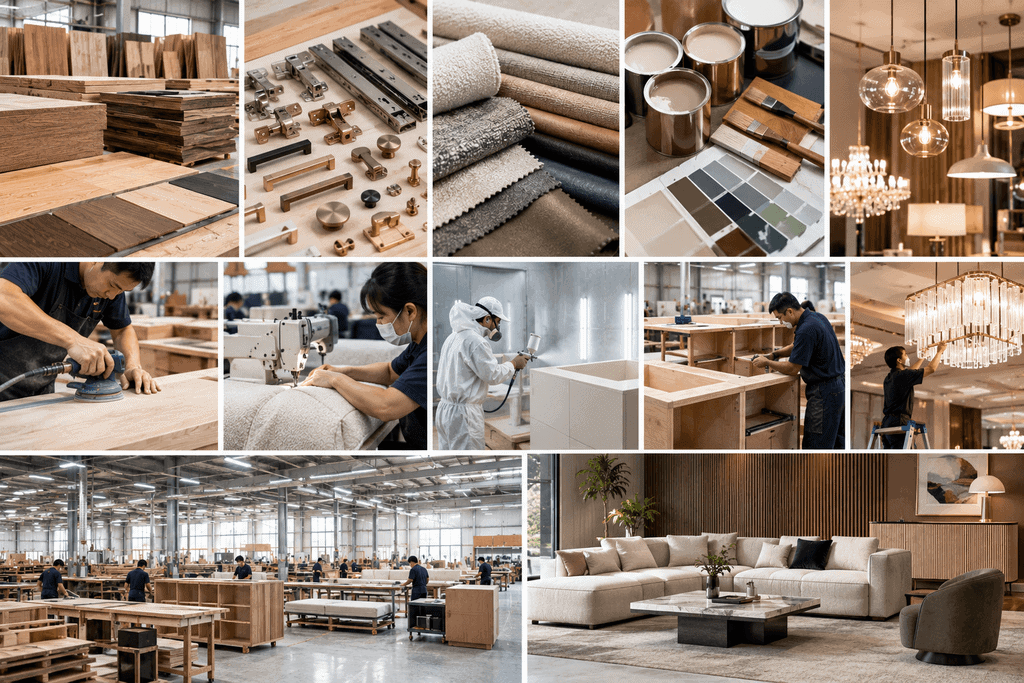
China’s mature and complete supply chain
When does custom furniture make sense?
There are a few situations I come across quite often.
1. You really love a particular design, but you cannot easily buy the original
Maybe you found a beautiful piece on Pinterest, Instagram or a designer’s website.
You really like it, but it is not easily available in your country, or the purchasing process is not practical for your project.
In this situation, custom development can be an option.
2. You love a high-end or designer piece, but the original is too expensive
This is probably one of the most common situations I see.
You may love the design, but spending several thousand dollars — or much more — on one piece of furniture simply does not make sense for your project.
In this case, we can use the original design as a reference and develop a new version in China.
The goal is not to make a cheap copy.
The goal is to keep the design language, proportions and overall feeling that you like, while choosing materials and production methods that make sense for your budget.
3. You already have a designer’s rendering, sketch or concept
Sometimes the client already has a clear design.
Maybe it is a rendering from an interior designer, a hand sketch, or a concept they have developed themselves.
In this situation, we are not simply looking for an existing product.
We need to turn the design into something that can actually be manufactured.
4. You have an idea that does not exist as a ready-made product
Sometimes a client simply has a particular idea in mind, but there is nothing similar available as a finished product.
China’s mature furniture supply chain can be very useful in this situation.
We can look for the right type of factory and then work through the production details to develop the piece.
But after doing this for many years, I also believe that not everything needs to be custom-made.
Some products already have very mature ready-made options.
In those cases, buying an existing product may actually be easier, faster and more practical.
So when I look at a custom project today, I usually ask myself three questions:
Can it be made?
Is it worth developing?
Does it really need to be custom-made?
I always believe:
Custom furniture is not the goal. Solving the problem is the goal.
6 Things to Pay Special Attention To When Ordering Custom Furniture
The following are not tips I simply collected from the internet.
These are problems I have actually experienced in real projects.
And because I have encountered these situations again and again, I now pay much more attention to the details before production and throughout the process.
1. An AI image can be a reference, but it is not a production drawing
AI has become very convenient.
Sometimes a client sends me an AI-generated furniture image and says:
“I want this.”
I completely understand why.
An image is a very easy way to show what you like.
But an AI image is mainly a visual concept.
It can show the general shape, proportions and feeling of the furniture, but it usually does not tell the factory:
How should the internal structure be built?
What materials should be used?
How thick should each part be?
How should the different parts be connected?
What hardware should be used?
These are the details that actually determine how the furniture will be manufactured.
So I think AI images are very useful as a design reference, but they should not be used directly as production instructions.
Before production starts, the visual concept still needs to be turned into proper production information that the factory can understand and follow.
2. When a rendering is turned into CAD, some details can be missed
This is also something I have experienced in real projects.
Many times, the client gives us a rendering, and then the factory’s designer prepares the CAD drawing based on it.
The problem is that some details from the original rendering can be overlooked during this process.
It might be a small line, a rounded corner, a proportion, or a special structural detail.
It may look very obvious in the rendering, but it may not be fully reflected in the CAD drawing.
And once production starts, the factory will normally follow the confirmed CAD.
So now, when I work on this type of project, I pay special attention to checking the rendering and CAD drawing side by side.
The rendering shows what the client originally wanted.
The CAD drawing is what the factory actually uses for production.
These two things need to match.
Sometimes the person preparing the drawing may think a certain detail is not important, or may simply make it more standard for production.
But that small detail may actually be one of the reasons the client liked the original design.
This is something I pay much more attention to now because I have seen it happen in real projects.
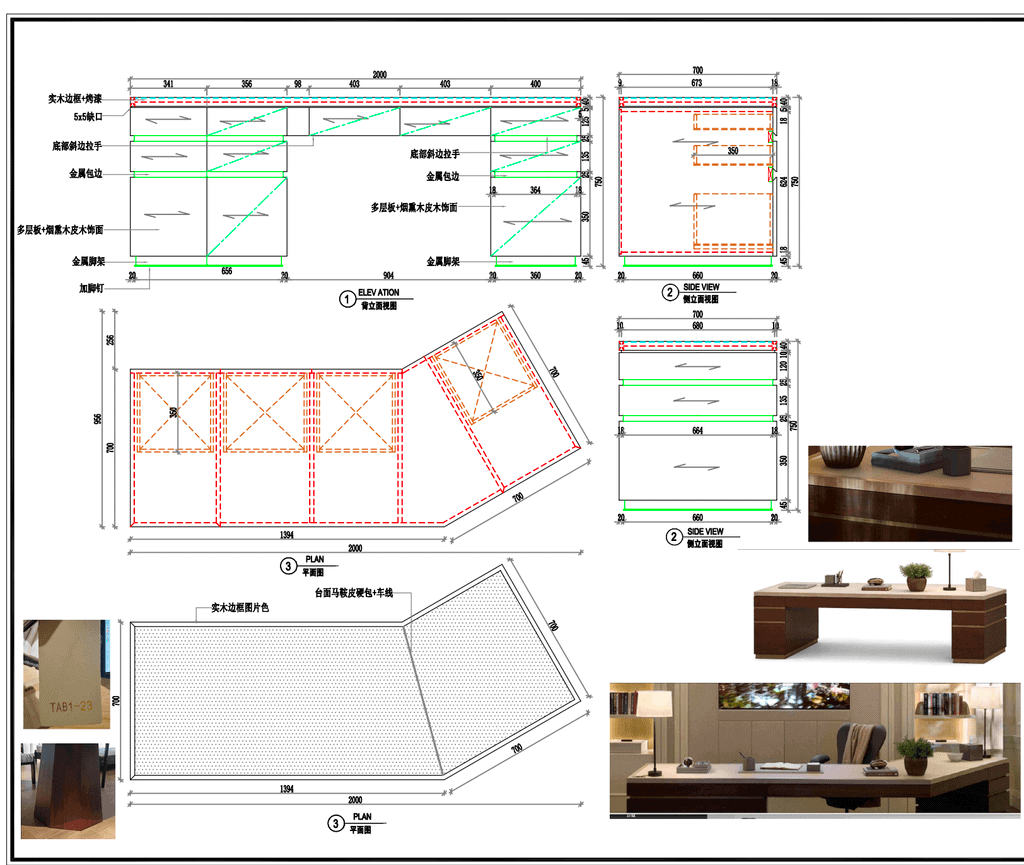
Production CAD
3. Always confirm important colors on the actual material
Color is another area where problems can easily happen.
A client may send me a picture and say:
“I want this color.”
But the same color can look very different on different materials.
Wood, paint, fabric, leather and metal can all present the same color differently.
And of course, the color you see on your phone or computer can also be different from the actual material.
So if the color is important, I recommend confirming it with a physical sample of the actual material whenever possible.
If the final product uses a particular type of wood, it is better to check the color on that actual wood.
If it is fabric, check the actual fabric.
I have had projects where the color looked very similar in pictures, but once the product was actually made, it still looked different.
If we can confirm these things earlier, it is much better than discovering the problem after the product has already been made.
4. Choosing the right factory is very important
Some furniture looks quite simple from the outside, but once you start making it, there may be many different processes involved.
For example, woodworking, painting, upholstery and hardware.
If one product requires several different factories to work together, the whole process becomes much more complicated.
One factory may make the wooden frame, another may do the painting, another may handle the upholstery, and then everything needs to come back together for final assembly.
Every additional step creates another point that needs to be coordinated and controlled.
So for more complicated custom furniture, I usually prefer to work with a factory that has relatively complete production capabilities and strong overall control.
This makes it easier to manage both quality and lead time.
For many custom projects, I usually allow around 45–60 days for production, although the actual time depends on the complexity of the product and the factory’s production schedule.
If several factories are involved, the timing can become much harder to control
5. Don’t wait until final inspection to discover problems
This is something I pay particular attention to now.
If a problem is only discovered during final inspection, it can already be too late.
If we find it at the CAD stage, it can be changed.
If we find it during material confirmation, it can still be adjusted.
If we find it at the beginning of production, there is usually still a chance to deal with it.
But if the product is already completely finished, fixing the problem can become much more difficult.
So now, when I work on custom furniture, I try to follow the project through several stages:
Design / CAD → Materials and colors → Production → Process follow-up → Final inspection
The earlier we find a problem, the easier it is to solve.
That is why I don’t simply wait until the final inspection to check a custom product.
6. There may be some differences, but the overall result can be very close
There is another point I think clients should understand from the beginning.
When we develop a piece of furniture based on a reference image, there may be some small differences in the final product. This is normal, especially when different materials, finishes or production methods are involved.
For example, the wood grain may not be exactly the same, or the color and texture of the material may have slight differences from the original.
But when the design, proportions, materials, colors, details and workmanship are properly confirmed before production, the final result can be very close to the original reference and usually within an acceptable range.
For me, the important thing is not to make a promise based on a fixed percentage of similarity.
Instead, I look at the overall result:
Does the shape look right?
Are the proportions right?
Are the materials and colors close?
Does the overall design feeling match the original?
These are the things that really matter when developing custom furniture.
Every project is different, but with the right reference, proper CAD drawings, material confirmation and good production control, it is possible to achieve a result that is very close to the original design.
So, how do I look at custom furniture in China today?
After doing this for so many years, when I see a custom furniture project today, I don’t just look at whether it looks beautiful.
I first ask myself:
Can it be made?
How should it be made?
Where are the potential problems?
Is it worth custom developing?
Sometimes the answer is yes.
Sometimes the design needs to be adjusted.
And sometimes I will even tell the client:
You actually don’t need to custom-make this. A mature ready-made product may be a better option.
I think this is where real value comes into the sourcing process.
It is not about saying “yes” to everything the client asks for.
It is about looking at the actual production, cost, timing and final result, and deciding which approach makes the most sense for the project.
What really attracts me to custom furniture in China is not just the price.
It is the mature supply chain behind it.
It gives clients more choices and makes it possible to turn something that was originally just a design concept into a real piece of furniture that can actually be manufactured.
So if you have a design you really like but you are not sure whether it can actually be made, I don’t think the best first step is simply to ask a factory for a price.
It is better to first understand:
Is this design suitable for development?
How should it be developed?
What type of factory should make it?
What details need to be confirmed before production?
If these things are thought through properly at the beginning, the production process will be much smoother.
If you are considering custom furniture from China
If you already have furniture images, Pinterest references, AI images, a designer’s rendering, a sketch or CAD drawings, you can send them to me.
I can first help you look at whether the product is suitable for custom development, how it should be approached, what type of factory would be suitable, and what needs to be paid special attention to before production starts.
I started working in furniture sourcing in Foshan in 2013.
What I’ve shared here is not theory I found online. It is experience I’ve built up project by project over the years.
If you are considering custom furniture from China, you can send me your project first, and we can take a look at whether your idea is actually suitable for production.
Related Articles
If you found this article helpful, you may also enjoy these guides: